A guide to John 15
Abiding in Christ: what John 15 says and how to practise it
To abide in Christ is to remain in him, the way a branch stays joined to the vine, trusting him as the source of your life instead of your own effort. Jesus teaches this in John 15, the passage most often turned to on the subject.
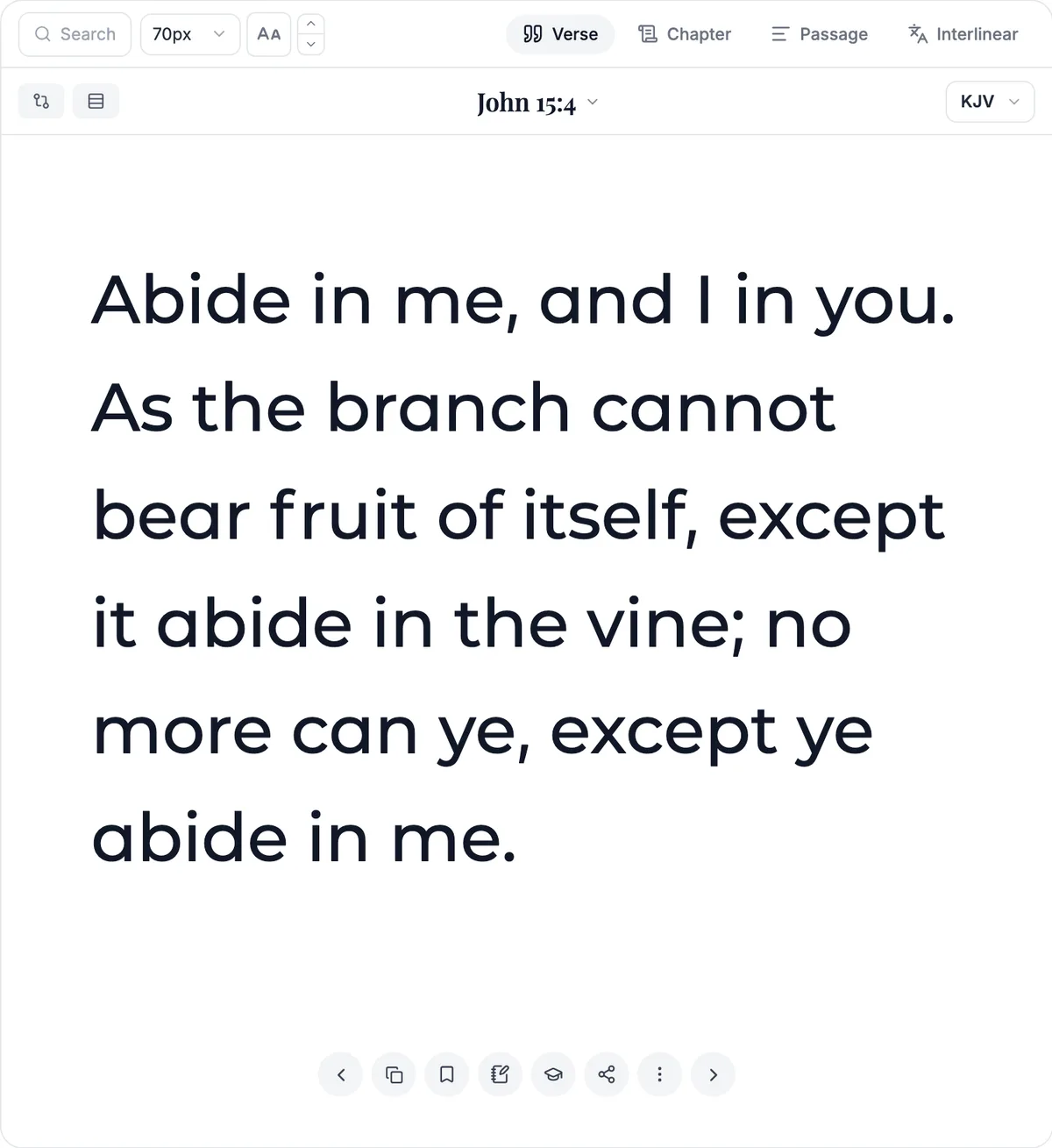
The picture Jesus uses
In John 15 Jesus tells his disciples, "I am the true vine, and my Father is the husbandman." The disciples are the branches. A branch has one job that matters here: it stays attached, and the life of the vine flows into it.
The heart of the passage is verse 4.
Abide in me, and I in you. As the branch cannot bear fruit of itself, except it abide in the vine; no more can ye, except ye abide in me.
What abiding is
The King James Version says "abide". In the same passage it also says "continue" (verse 9) and "remain" (verse 11), and these are the same idea: to stay, to stay put. Abiding is not a feeling you have to produce. It is staying joined to the one who gives life.
Verse 5 states what that means for fruit.
I am the vine, ye are the branches: He that abideth in me, and I in him, the same bringeth forth much fruit: for without me ye can do nothing.
What Jesus says comes with it
Jesus ties abiding to his words, to obedience and to love. He says that if his words abide in us, we may ask what we will (verse 7). He says that keeping his commandments is how we stay in his love, as he kept his Father's commandments and stayed in his love (verse 10). And he gives the purpose of it all in verse 11.
What about the branches that are taken away? Jesus speaks of branches that bear no fruit and are taken away (verse 2). The Greek verb there, airō, can mean "lift up" or "take away", and John uses it both ways. Verse 2 also plays on two similar-sounding verbs, "takes away" (airei) and "prunes" (kathairei), which leads into "you are already clean" in verse 3.
Verse 6 says who the burned branches are: "If a man abide not in me, he is cast forth as a branch, and is withered." Jesus names one thing about them, that they did not abide. And in John 15:4 abiding goes both ways: "Abide in me, and I in you." Someone who has Christ in them is one who abides in him. Those who are cast out never had that union. Jesus says the same in Matthew 7:22 and 23, where many say "Lord, Lord" and he answers, "I never knew you." They were not people he knew who then fell away. He never knew them.
This is the reading this page takes, and it matches 1 John 2:19, which says of those who left, "they were not of us; for if they had been of us, they would no doubt have continued with us." Some Christians read the "in me" of verse 2 as a real union that can be lost. Read the passage for yourself and, if you are unsure, take it to your pastor or a trusted commentary.
These things have I spoken unto you, that my joy might remain in you, and that your joy might be full.
A way to practise it this week
There is no single method, but a simple pattern keeps you in the text. Here is one way to do it with Bible ProJection, all free and with no account.
First, read the whole passage. Open John 15 in Chapter view and read verses 1 to 11 straight through. Second, slow down on one verse. Switch to Verse view, as in the picture above, and stay on John 15:4 until you can say it from memory.
Third, look at the word. In Interlinear mode the word translated "abide" is the Greek menō (Strong's G3306), which means to remain or stay. Seeing it in the original makes the repeated "abide" in the passage easier to follow. Fourth, search the theme. In the Study tab, search for "abide" and read how the word runs through the Gospel of John and the letters of John. Finally, keep it in front of you. Meditate has a Union with Christ deck of confessions, each paired with a verse, which you can set to advance on a timer.
Questions people ask
To abide is to remain. In John 15 Jesus uses the picture of a branch that stays joined to the vine, and says his followers should stay joined to him, because apart from him they can do nothing.
The main passage is John 15:1 to 11. The theme continues in the letters of John, for example 1 John 2:6 and 2:24, which speak of abiding in him and letting what you heard from the beginning abide in you.
The Greek word is menō, Strong's number G3306. It means to remain, stay or continue, which is why the King James Version also uses "continue" and "remain" in the same passage.
John 15 points to staying in his words, keeping his commandments and remaining in his love. In practice that means reading Scripture, praying, obeying and meditating on his words. There is no single required method.