A guide for beginners
How to read the Bible for beginners
The best way to start reading the Bible is to begin with one short book, such as the Gospel of John, and read a chapter a day with a plain-language translation. Read it for what it says, not for what you expect it to say, and you will understand more each week.
Why read it at all
The Bible is a library of sixty-six books written over many centuries, and Christians read it because they believe it is God speaking. The psalmist put the reason simply.
Thy word is a lamp unto my feet, and a light unto my path.
Do not start at Genesis 1 and push on
Many people begin at the first page and give up somewhere in Leviticus. You are allowed to start elsewhere. The Gospel of John is a good first book because it tells you who Jesus is and why it matters, in clear and fairly short chapters.
A good order after John is Romans, then Ephesians, then Hebrews. Romans lays out the gospel and how a sinner is made right with God. Ephesians shows what that means for who you are in Christ. Hebrews shows why his one offering is enough. Romans is the longest and most demanding of the three, so take it slowly, a chapter at a time. Later, go back to Genesis, and read the Psalms alongside, because they are made to be read slowly and often.
Five habits that help
First, read a chapter at a time, not a verse. A single verse can be bent to mean almost anything, but a chapter shows what the writer was saying. Second, read the same chapter twice, once for the story and once for the detail. Third, keep a pace you can hold, such as one chapter a day, and let a missed day pass without guilt.
Fourth, ask three questions of every passage. What does it say? What did it mean to the first readers? What does it mean for me now? Do them in that order, because the second question guards you from reading your own thoughts into the text. Fifth, write down one thing you noticed, even a single line.
Choosing a translation
Translations differ in how closely they follow the original words and how easily they read. The King James Version is a classic and is in the public domain, but its English is four centuries old. A literal translation, such as Young's Literal Translation, stays very close to the Hebrew and Greek, which helps for study but can read stiffly.
It helps to read in one version and check a hard verse in a second. In Bible ProJection, Compare with lets you tick the translations you want and read them together under each verse.
Read like the Bereans
The book of Acts praises a group of people for how they listened to Paul.
These were more noble than those in Thessalonica, in that they received the word with all readiness of mind, and searched the scriptures daily, whether those things were so.
Reading it in Bible ProJection
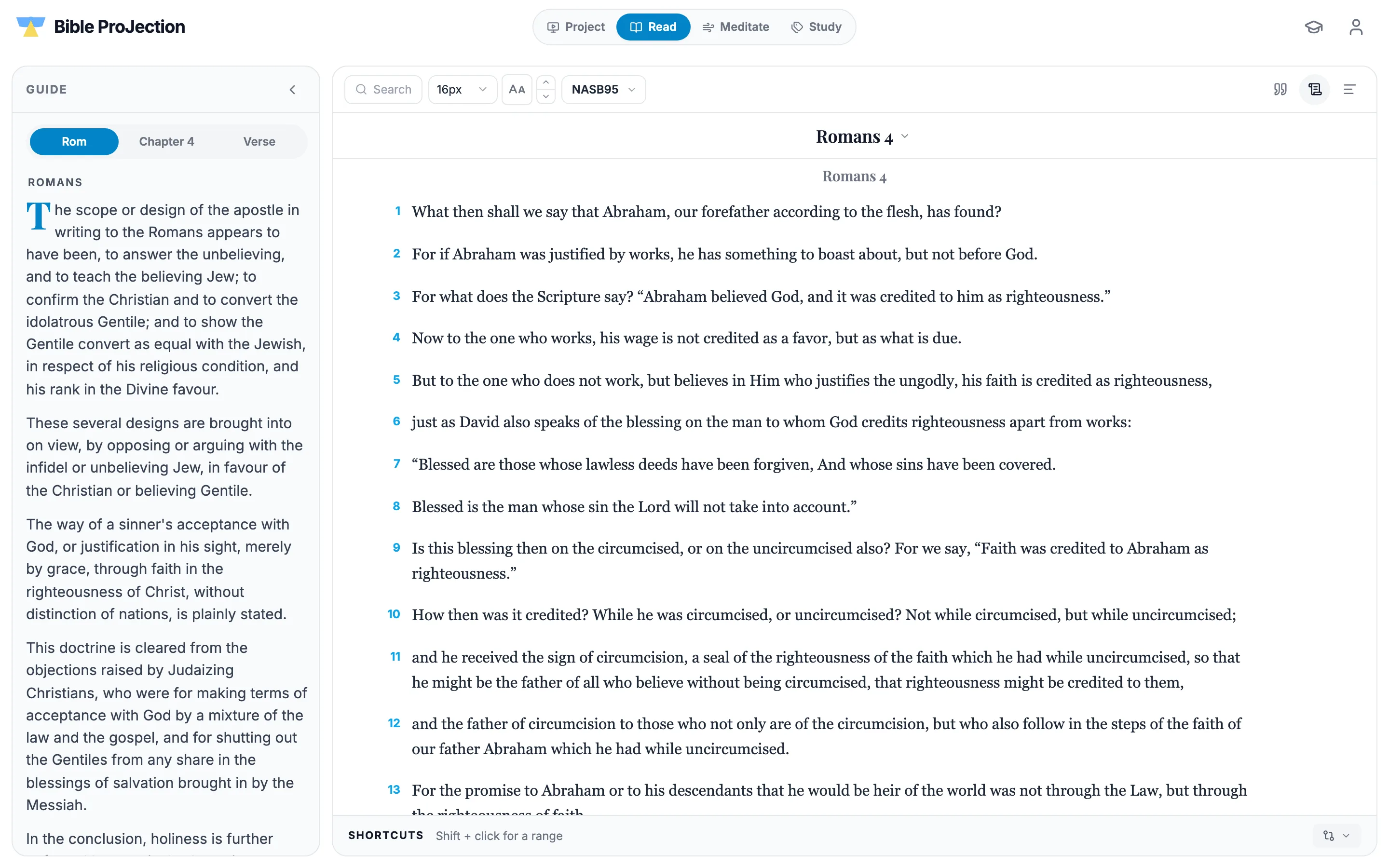
Open Chapter view to read a whole chapter straight through, as in the picture above. The Guide in the sidebar gives an introduction to the book and an outline of the chapter from Matthew Henry's Concise Commentary, and the footprints button in the top bar takes you back to the last places you read. You can bookmark any verse with one tap. It is free to use in your browser.
Questions people ask
The Gospel of John is a common first choice. It is short, clear, and introduces Jesus. Many readers then go to Romans, Ephesians and Hebrews, in that order.
One chapter a day is a pace most people can keep. Reading it twice, once for the story and once for the detail, is better than reading three chapters quickly.
One you will actually read. A plain-language translation is easiest to begin with, and checking a hard verse in a second version helps. Bible ProJection offers several, free.
You can, but it is not required, and many people stall in Leviticus. It is fine to start with John, and read the Old Testament later.